
Sphereon
application notes
How and why to govern digital decisions
Verified evidence proves a credential is genuine, but it does not tell you how to act on it or why a specific action is justified.
Organizations increasingly receive digital information: credentials from wallets, signed digital documents from partners and customers, and confirmations from automated systems. Standard verification answers one question well: is this object genuine and unaltered.
However, it leaves three fundamental business questions unanswered.
Three business questions, one governed decision
Is the data correct?
A bank approves against the wrong figure. “Verified” meant the file was uploaded and the name matched, not that the amount was checked.
The credential was genuine. The meaning was not.
The solution: a semantic layer that defines what a fact means, including its legal basis, trust level and sensitivity, before anyone acts on it.
May this action proceed?
A valid training credential unlocks the machine. The training was for another machine type, and no one authorized this person for the task.
The credential was genuine. The action should never have proceeded.
The solution: a policy layer that decides, against external rules and internal policy, if a verified request may actually proceed.
Can we prove it afterwards?
A medical authorization is approved on genuine credentials. 18 months later, no one can show which mandate was valid or which rule applied.
Everything was logged. The decision is still undefendable.
The solution: an evidence layer that records why a decision was justified and keeps that record tamper evident.
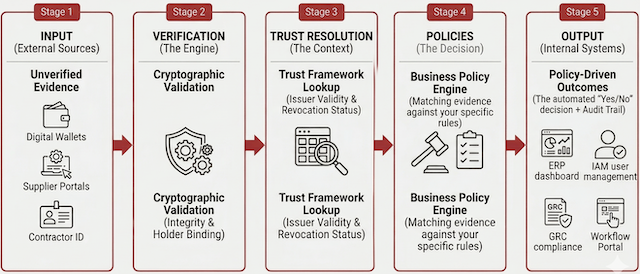
The three form one governed decision flow
Meaning, enforcement, and evidence are not separate products. They are the three things that have to be true for a verified piece of evidence to become an action you can take and defend: it must mean what you think, it must be allowed, and it must be provable later. Governing all three at the point of decision is what turns verified data into a decision you can stand behind.
These application notes exist to answer exactly that. They explain the mechanics and the business logic behind turning raw verified data into governed, policy-controlled decisions that protect your organization before, during, and after an action is taken.
A low-commitment first step
Each layer can be proven on one high-value decision in a focused, four-week accelerator, before any larger commitment. It is a decision to learn, not a decision to build a platform.