
SKILLS-BASED
WORKFORCE MOBILITY
Life long learning and career transitions
Empowering organizations, training providers, and sector initiatives to assess existing skills, identify gaps, support targeted upskilling, and issue verifiable credentials that help people move into work, into new roles, or into further training.
Continuous professional development requires a reliable way to make invisible capabilities visible. By moving away from rigid, diploma-first systems, we can create alternative pathways for talent. This ensures smoother career transitions and allows individuals to clearly prove what they can do, exactly when it matters.
Why this matters
Many highly capable individuals remain overlooked because their practical experience isn’t formally recognized. Meanwhile, employers face widening talent shortages and strict compliance requirements, demanding a faster, more reliable way to assess, retrain, and redeploy their workforce safely and efficiently.
Where this creates value
Cross-sector mobility
Organizations facing critical shortages can efficiently re-train talent from other sectors.
By verifying existing skills and knowledge, employers can target specific missing competencies and smoothly transition workers into new, high-demand contexts without forcing them to start from scratch.
Internal role transition
Older, experienced employees can easily move into less physical but equally valuable positions.
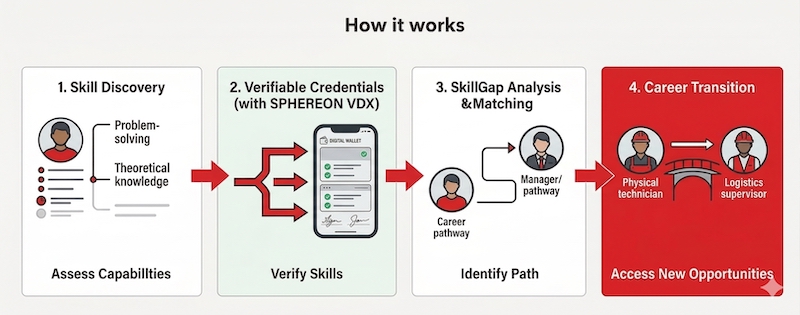
For example, a technician could transition into logistics, safety oversight, airline maintenance planning, or customer care by digitally proving their foundational expertise and earning targeted, verifiable skill upgrades.
Alternative talent pathways
Individuals outside formal education can confidently prove practical capabilities and progress.
Whether it’s a young person mastering jewel repair, or as an artist, or a person with a disability building a creative portfolio, or a talented athlete learning teamwork on the field, portable proofs ensure non-traditional talent is recognized and mobilized.
How it works
What can be issued
- Intake assessment results
- Practical skills and demonstrations
- Theoretical learning outcomes
- Micro-credentials for partial progress
- Fully achieved competencies
What this enables
- Better matching between people and roles
- Targeted and measurable upskilling
- Portable proof for employers and providers
- Reduction in recruitment and training costs
- Verified pathways for non-traditional talent
Operational outcomes
Accelerated time-to-work
Streamline the transition from skill discovery to active deployment.
By replacing manual vetting of paper resumes with instant digital verification, organizations can slash the time it takes to move a person from an initial assessment into a productive role.
Precision talent matching
Replace high-level job descriptions with verifiable capability data.
Digital skill credentials allow for much more accurate matching between a person’s actual capabilities and the specific requirements of a role, reducing mis-hires and improving long-term retention.
Trusted paths for all talent
Bring non-traditional and artisanal skills into the formal economy.
By providing a cryptographically secure way to prove practical experience, whether in craft, sports, or community work, you build a trusted bridge for people who lack formal diplomas but do possess high-value capabilities.
Ready to mobilize your workforce?
Contact our team to discuss how verifiable skill credentials
can transform your sector or organization.