
Sphereon EDK
Enterprise Development Kit
Deploy secure, production-ready infrastructure for credential enforcement.
The Enterprise Development Kit (EDK) provides the containerized runtimes, secure key management, and policy enforcement engines required for high-assurance environments.
While the IDK provides core libraries, the EDK is built for engineering teams who need to deploy secure, scalable infrastructure for real-time safety enforcement and compliance.
By integrating with HSMs and QTSPs, the EDK ensures your trust architecture is auditable, NIS2 compliant, and ready for production-grade duty of care.
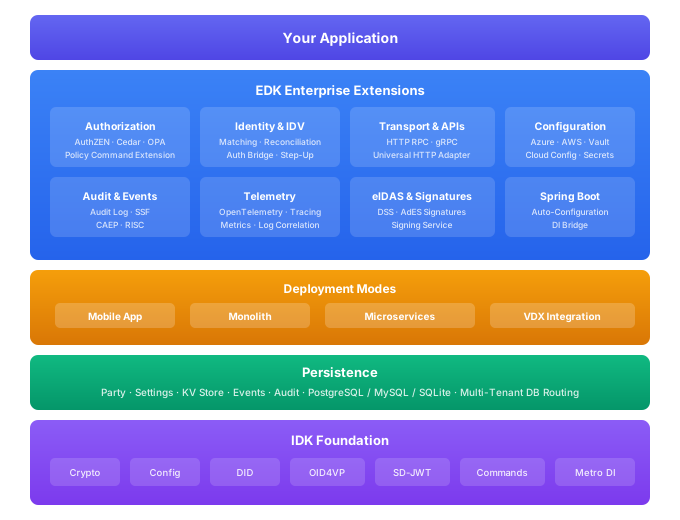
Core technical capabilities
Production-grade runtimes
Deployable, containerized environments designed for high-availability production use. Includes pre-configured persistence layers and administrative interfaces to manage the lifecycle of your identity infrastructure.
Enterprise key management
Move beyond local software keys. The EDK integrates natively with Hardware Security Modules (HSMs) and Qualified Trust Service Providers (QTSPs) to provide legally binding signatures and secure key custody.
Dynamic policy enforcement
Configure complex business and safety rules that are evaluated in real-time. Return secure “Go/No-go” decisions directly to machine controllers, access points, or enterprise applications.
Auditable evidence generation
Satisfy NIS2 and regulatory requirements with automated, immutable audit trails. Every decision is recorded with cryptographic proof, providing a defensible record for insurance and compliance.
From deployment to enforcement: how it works.
1. Deploy
Launch the containerized EDK runtime within your secure cloud or on-premise infrastructure.
This establishes the scalable backbone of your trust architecture, including pre-configured database adapters and administrative interfaces.
2. Secure
Integrate with enterprise key management systems, HSMs, or Qualified Trust Service Providers.
Ensure that all credential operations meet legal and regulatory standards for high-assurance environments through secure, hardware-backed key custody.
3. Define
Configure the policy engine with your specific business, safety, or compliance rules.
Define the requirements for access—such as valid certifications or site inductions—that must be met before a digital or physical action is authorized.
4. Enforce
Enable real-time decision making based on set policies at the point of access or transaction.
The EDK evaluates incoming proofs against your active policies to return an immediate, cryptographically signed “Go/No-go” decision to your systems.
Ready to secure your production infrastructure?
Speak with our team to see how the EDK provides the enforcement layer for your industrial safety, workforce compliance, or high-assurance credential pilots.