
SPHEREON IDK
Identity Development Kit
Build digital identity and credential applications with full control.
The Identity Development Kit (IDK) provides the foundation: the open-source cryptographic and protocol building blocks required to implement secure credential issuance and verification flows.
The Identity Development Kit (IDK) is a Kotlin Multiplatform library for building digital identity applications. It provides a modular, standards-based foundation for credential issuance and verification, identity proofing, trust establishment, and secure data exchange, all from a single codebase that compiles to Android, iOS, JVM, JavaScript (browser and Node.js), WebAssembly, and Linux native.
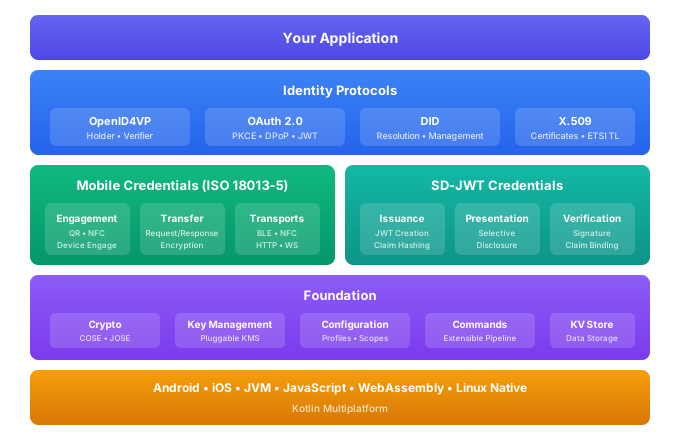
Core technical capabilities
Standard-based protocols
Native support for OID4VCI, OID4VP, and SIOPv2. Implement secure credential issuance and verification flows without re-inventing the underlying standards or complex protocol logic.
Advanced cryptography
Comprehensive support for SD-JWT, JSON-LD, and BBS+ signatures. Handle selective disclosure and complex credential formats out of the box with mathematically verifiable certainty.
Multi-platform availability
Optimized for high-performance Kotlin and Java server environments, with community-supported libraries for TypeScript and JavaScript developers working on web or mobile applications.
Modular and extensible
Built on a modular plugin architecture. Easily integrate custom data stores, key management systems (KMS), or proprietary credential formats as your application requirements evolve.
From integration to implementation: how it works.
1. Integrate
Import core libraries into your own specific development environment.
This provides your project with the foundational cryptographic and protocol handlers required for decentralized identity.
2. Configure
Define trust anchors, protocol endpoints, and supported formats.
Initialize the identity agent with modular plugins for OID4VCI, OID4VP, and specific key management systems.
3. Implement
Build the application logic and user interface for your custom wallet or agent.
Leverage high-level API calls to manage the lifecycle of credentials, including issuance, storage, and presentation.
4. Scale
Transition to production-ready infrastructure and enforcement layers.
Move from local development to scalable, containerized environments by integrating with the Enterprise Development Kit (EDK).
Ready to build your identity infrastructure?
Speak with our team to see how the IDK fits into your specific architecture, from custom wallets at scale to automated verification flows.